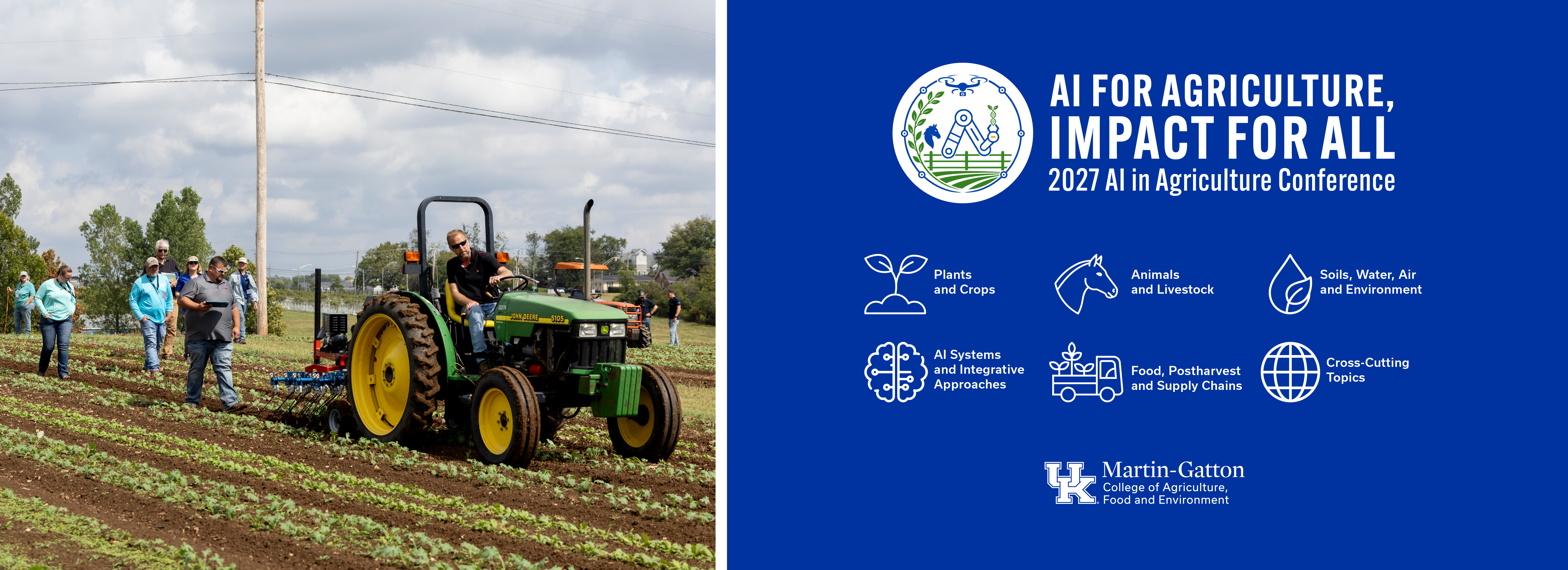
Talks, Presentations and Workshops cover the full range of AI in agricultural research and applications:
- Plants & Crops 🌿: AI-driven precision agriculture, high-throughput phenotyping, genomic-to-field modeling, hyperspectral and UAV-based pest and disease detection, and ML-enhanced crop growth simulation across genotype*environment*management (G×E×M) interactions. Specifics: Soil health, nutrient cycling, GHG monitoring, climate adaptation, and water modeling.
- Animals & Livestock 🐄: AI-integrated precision livestock farming - Sensing, automation, health and welfare monitoring, and production optimization for poultry, swine, dairy, beef, and aquaculture. Specifics: PLF, wearable sensors, welfare scoring, aquaculture, and animal health prediction.
- Soils, Water, Air & Environment 🌍: AI-enabled soil microbiome characterization, AI for soil health, nutrient and water management, climate adaptation, and environmental monitoring. Specifics include soil health, nutrient cycling, GHG monitoring, climate adaptation, and water modeling.
- Food, Bioprocessing, Postharvest & Agribusiness Intelligence 🏭: Intelligent sensing and analytics for food quality, safety, bioprocessing, packaging, logistics, traceability and AI-driven farm enterprise modeling, market signal integration, risk and insurance analytics, resource allocation optimization, carbon and sustainability accounting, and data-driven financial decision support for farm operators and agribusinesses. Specifics: Autonomous laboratory for food and bioprocessing applications, AI-driven nondestructive testing method, quality grading, AI-driven smart packaging, food safety, shelf-life prediction, traceability, and logistics AI.
- AI Systems & Integrative Approaches 🤖: Autonomous field and indoor robotics, mechatronic automation, AI-guided autonomous and semi-autonomous field equipment, machine vision for selective harvesting, predictive maintenance of agricultural machinery, physics-informed and data-driven digital twins, multi-scale decision-support and prescriptive analytics platforms, explainable AI (xAI), and responsible AI governance frameworks for agri-food systems. Specifics: robotics, digital twins, xAI, decision support systems (DSS), and responsible AI.
- Cross-Cutting Topics 🌐: Extension and outreach, workforce development, education, policy, and socioeconomic adoption of AI technologies. Specifics: Extension, AI policy, equity and access, adoption barriers, and education.